Group stage and playoffs
How a group tournament works on ManaLadder: from the draw through the match room and the group table to the way the playoffs are paired. The rules here are the ones the app follows.
The short version
- The groups are drawn at random among those present, and everyone in a group plays each other once.
- All your matches are out at once under Group stage. Agree on the time in the match room, and play before the deadline.
- A win gives 3 points, a draw 1. On equal points, your head-to-head match decides.
- The best from each group advance. If it doesn't add up, the playoffs are filled up with the best of the next.
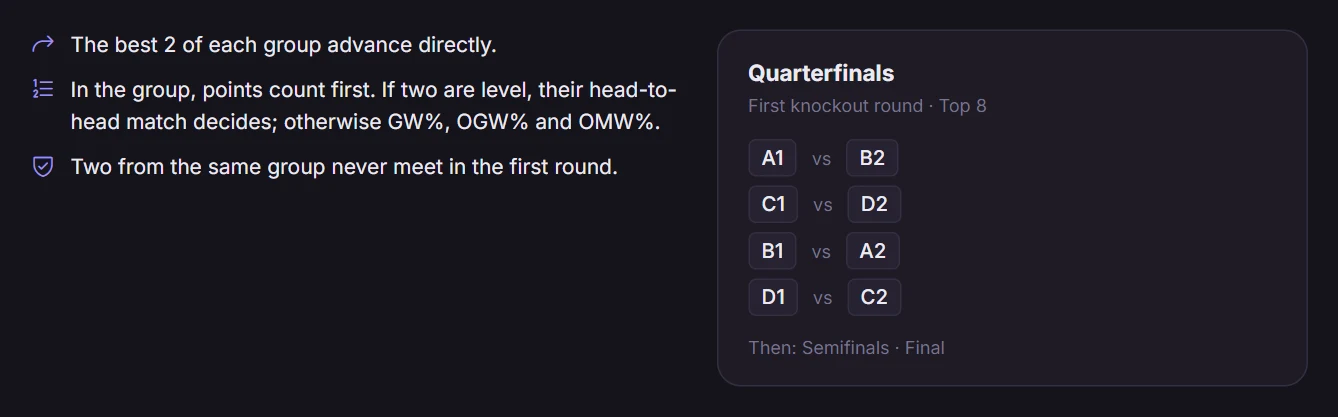
- The playoffs cross the groups: the winner of one group meets the runner-up of another, and two players from the same group never meet in the first round.
1. The groups
The organizer chooses the number of groups, how many advance from each, and the size of the playoffs. The app recommends a setup based on the field: groups of about four, two through from each, and the smallest playoff that fits them.
When the tournament starts, the groups are drawn at random among those who have shown up. The players are dealt out like cards, so the groups differ in size by at most one player. There is no seeding by rating.
Until the matches are laid out, the groups are shown as provisional. The organizer can then swap or move players, add a latecomer to a group or redraw. Every change is recorded in the tournament log. Once the matches are laid out, the groups are locked.
2. The matches and the match room
In round robin the whole group stage is laid out at once: you see all your matches under Group stage and play them in whatever order suits you both. There are no table numbers and no round timer — instead the group stage has a deadline, shown on the round board. The organizer can also choose a fixed number of Swiss rounds within the group; then each round is paired separately, each with its own deadline.
Every match has its own match room. There you suggest a time under When are you playing?; when your opponent taps Suits me, the match is scheduled and you both get a notification. Under Are you streaming the match? you can add a Twitch or YouTube address, and under Messages you can write to each other — only the two of you and the tournament organizers can read them.
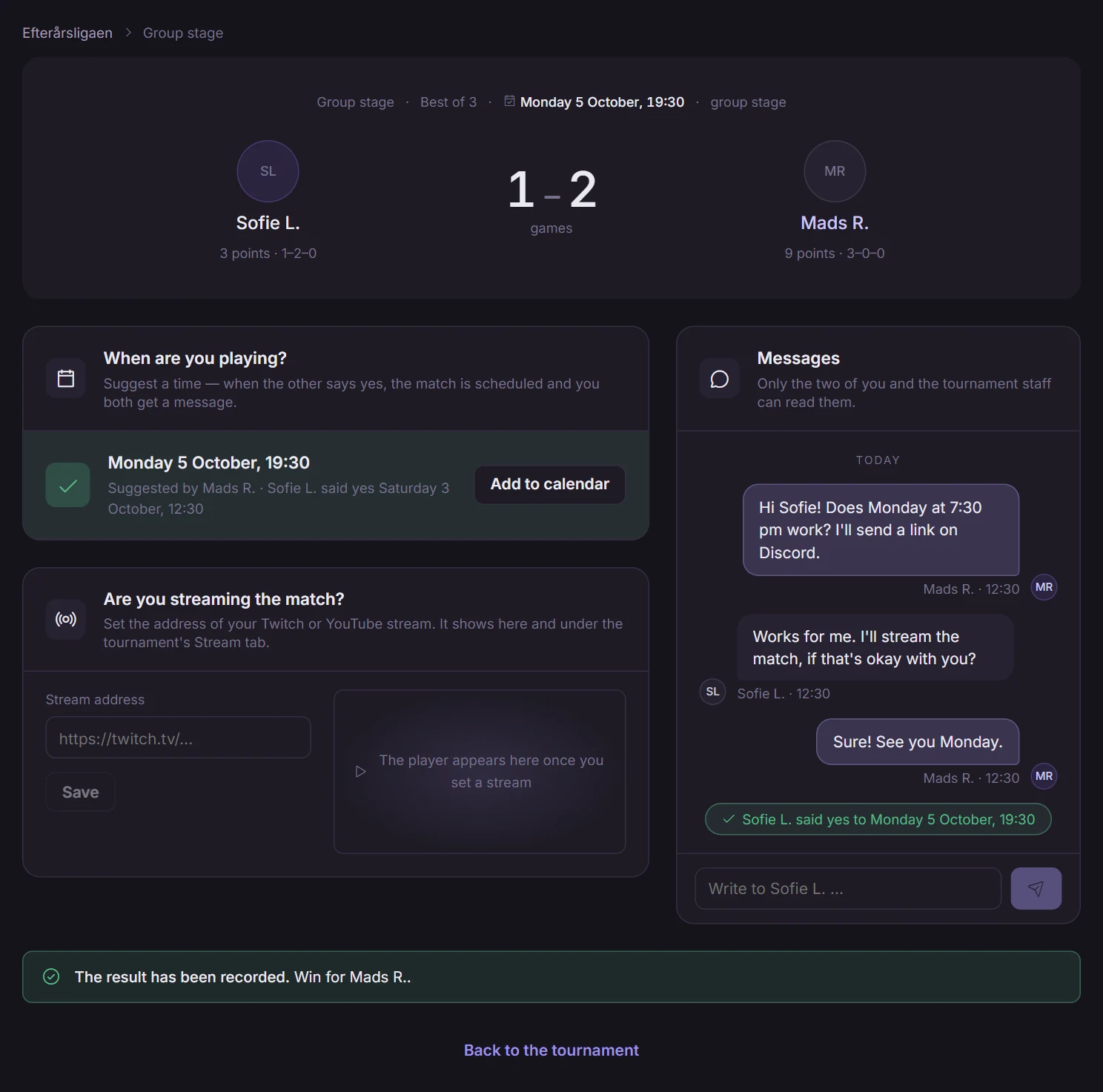
When the match has been played, one of you taps the score at the bottom of the match room. If it ended in a draw, the tournament's setting applies: either the draw counts, or the match is decided by a Chaos Orb flip. If the tournament requires confirmation, the opponent must confirm; otherwise the result counts right away.
Once the deadline has passed, the tournament administrator decides the matches still missing. It never happens automatically.
3. The group table
A win gives 3 points, a draw 1 and a loss 0. If players are level on points, the place is decided in this order:
- Head-to-head — when exactly two are tied and one has beaten the other.
- GW% — your own share of games won.
- OGW% — your opponents' average GW%.
- OMW% — your opponents' average match-win percentage.
- Head-to-head again — for the two who are still dead even.
- The draw order — so the table always has a single order.
Note that the group puts your own GW% before your opponents' percentages — in a group everyone has met the same players, so it's your own games that separate you. The percentages are calculated as in Swiss: an opponent's percentage counts as at least 33%, and automatic wins are left out. See the Swiss rules for the details.
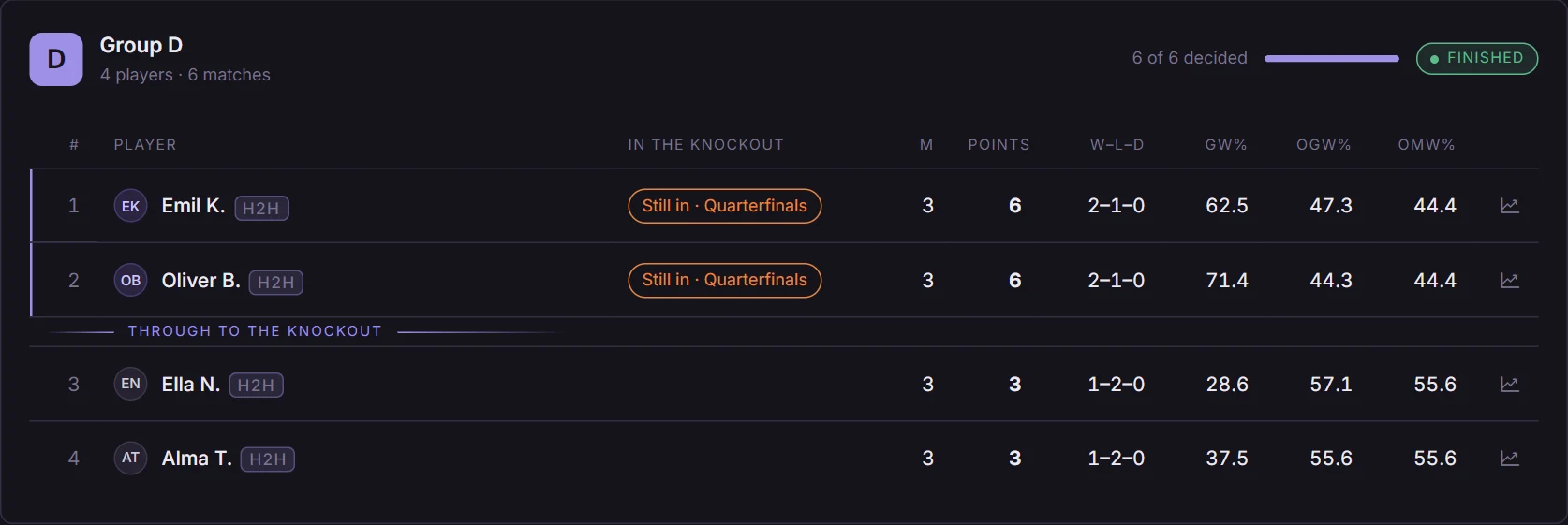
On the phone the percentages are folded away — tap Show tiebreakers under the group to see them. Once the playoffs are under way, the In the knockout column shows what each group place led to.
4. Who advances
The best in each group go straight through — the number the organizer has chosen. If the playoffs have more places than direct qualifiers, the rest are filled with the best of the next: with two through from each group, that's the best third-placed players across the groups.
The best of the next are compared on match-win percentage — not points — and then GW%, OGW% and OMW%. Match-win percentage is fair when the groups differ in size: a player in a group of four has played more matches than one in a group of three.
If a player drops in the middle of the group stage, the opponents in the matches not yet played get an automatic win: 3 points, but outside all percentage calculations. The played results stand. A player who has dropped keeps their place in the table but does not advance.
5. How the playoffs are paired
The first playoff round is fixed before a single match has been played — it follows from the setup alone. You can see it under Tournament info and under Standings with How to advance — and the first knockout round.
The crossover
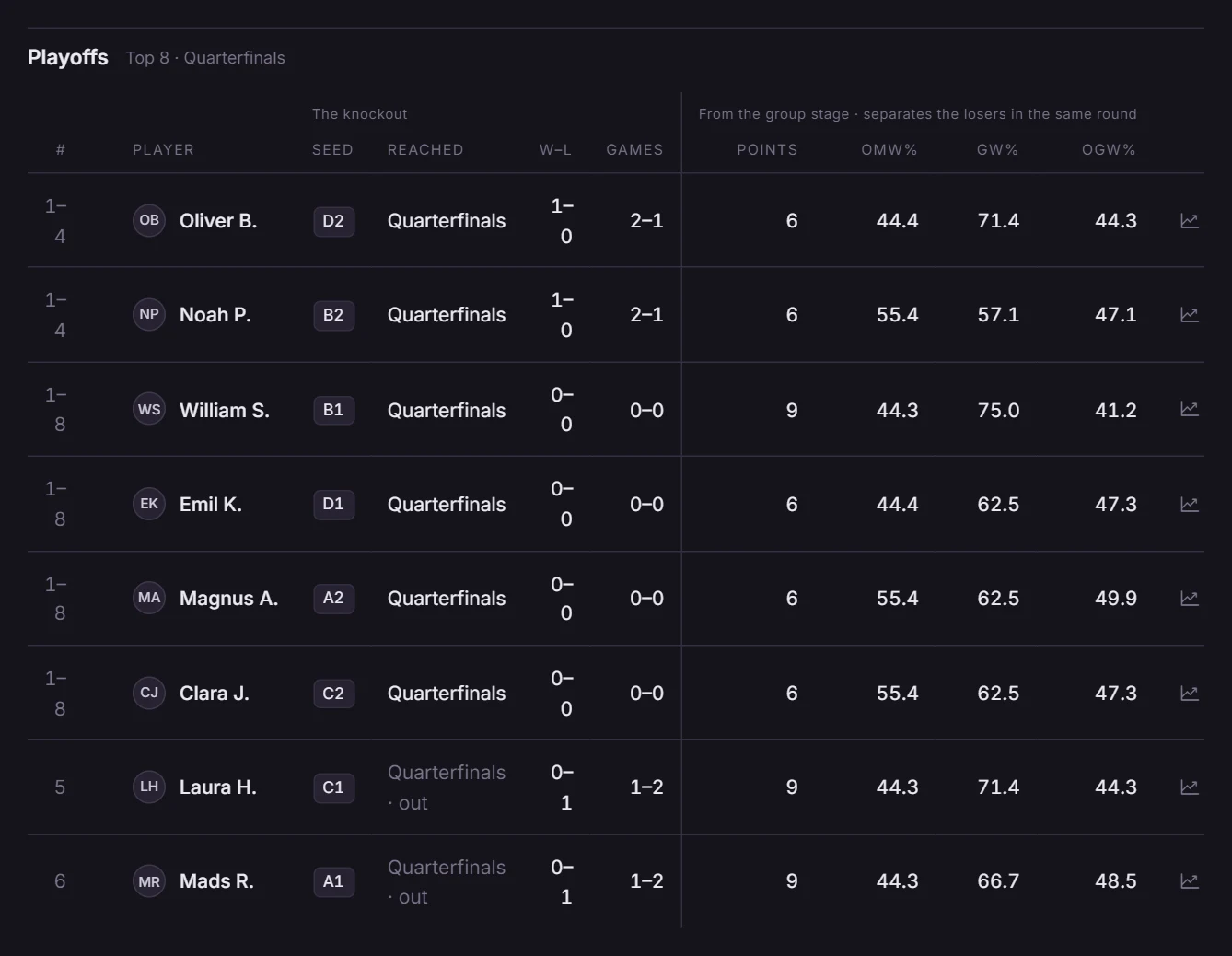
The groups are paired two by two — A with B, C with D — and the winner of one meets the runner-up of the other: A1 vs B2 and B1 vs A2. The matches are placed in opposite halves of the playoffs, so two players from the same group can meet in the final at the earliest. With four groups, the quarterfinals look like this:
The winner of the first match meets the winner of the second in the semifinal, and so on. The winner and runner-up of group A are in opposite halves and can only meet in the final.
When it doesn't add up
- An odd number of groups or fill-up places: the places that aren't part of a crossover — the last group without a partner and the best of the next — are lined up in that order and paired strongest against weakest: the first against the last, the second against the second-to-last.
- Two from the same group facing each other: if that happens in those places, the weaker of the two is swapped with the first other player who removes the clash.
- Only one through from each group, and the playoffs are filled up: then there are no runners-up to cross with. The group winners are seeded by their results, and the best meets the weakest of the best of the next.
Who fills a fill-up place is only known when the group stage is over — and so is whether the place has to be swapped. The plan says that it happens, but cannot show the swap in advance.
6. The playoffs and the placings
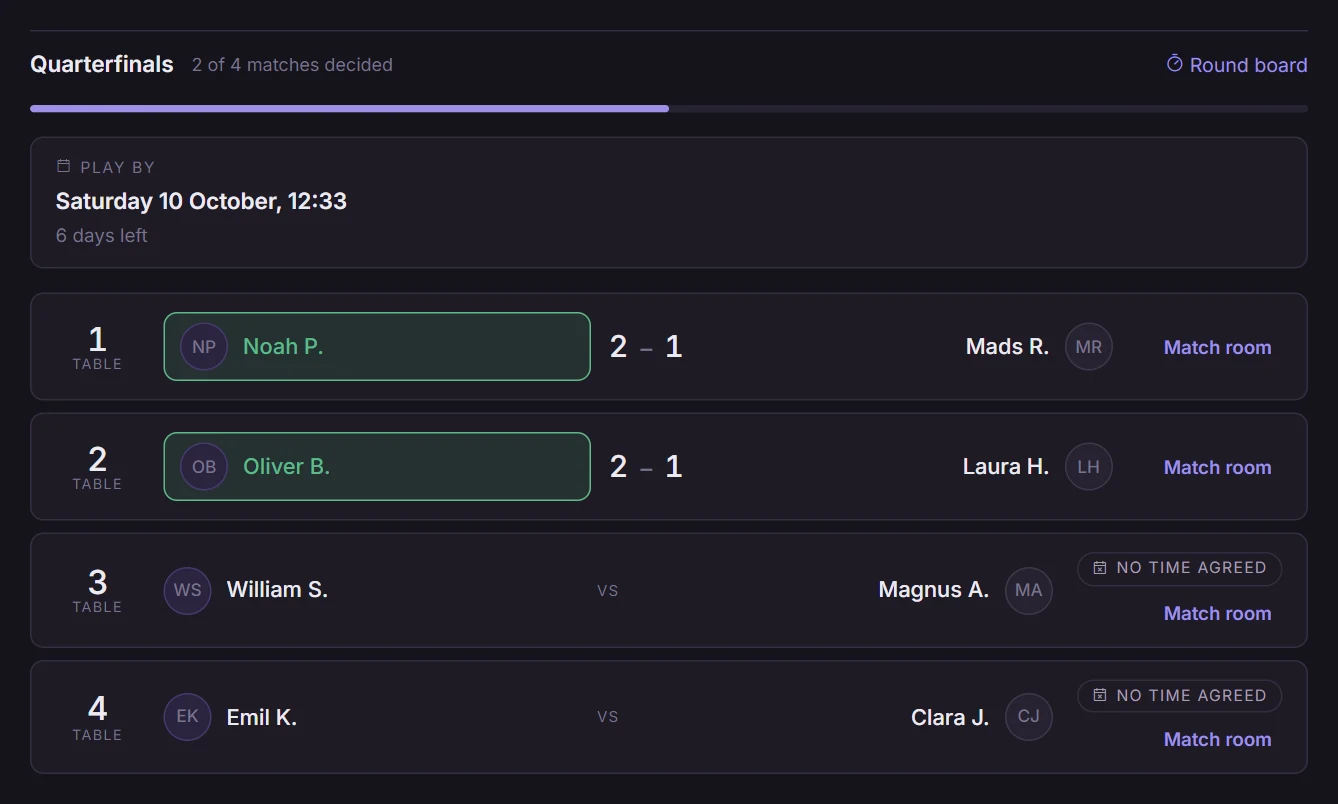
The playoffs are knockout: the winner advances, the loser is out. A playoff match must have a winner. Each round has its own deadline, and the match room works as in the group stage — time, stream and messages.
The winner of the final is no. 1, the losing finalist no. 2. Players knocked out in the same round don't share the place: they are ranked by the qualification order from the group stage — group winners first, then runners-up, then the best of the rest, each with their tiebreakers. If two lose in the semifinals, the better qualified one gets 3rd place.
Group tournaments don't count towards the rating — only public Swiss events do. The matches still appear in your history and on your profile.